
Laurent Dubois and the Pursuit of Cheese Excellence
Highlights from a renowned French fromager-affineur's 30 years in cheese
As AI becomes more present in conversations, business, and everyday life, it's all the more riveting to speak with cheese icon Laurent Dubois about his impressive career including how he made history as the first cheesemonger to win the prestigious Meilleur Ouvrier de France (MOF) title in 2000.
The Meilleur Ouvrier de France
MOF
The French Ministry of National Education organizes the rigorous contest to find and recognize the best in their crafts, and that year marked the debut of a newly added cheese category. “The particular difficulty of that first competition was that there was no point of comparison, since cheesemongers had never participated in the past. And we didn’t have the internet or social media; all we had were books and our experiences and exchanges with others,” Dubois recalls.
The competition included multiple stages of written and practical tests covering theory, milk science, the patrimony of the cheeses, knowledge of the animals, terroir, and affinage, as well as cutting, portioning, and presentation. The finalists were given a broad theme to create a masterpiece, evaluated on about 70 criteria ranging from creativity and theme coherence to cheese selection and taste.
Creating a Cheese Masterpiece

The Pyramid of Flavors with 120 cheeses that Dubois created in 2000 when he won the MOF title
The theme the first year was Pyramid of Flavors. Dubois’ interpretation involved selecting 120 cheeses—essentially every cheese in his shop, including some bespoke affinage cheeses that he worked on in the year before the competition. He classified the cheeses into 12 different flavors and presented them in an elaborate pyramid by flavor type, and age, with a poem integrated throughout the display to describe each section.
“The creative side had many different elements, to show depth beyond cutting and selecting the cheeses,” he explains. When asked about the poem, he shows me a notebook with a handwritten version (beautiful penmanship, I might add) that he had copied from photos of the original masterpiece years ago. Not currently accessible to ChatGPT, and quite moving to see in person.
He was one of four trailblazers who won the MOF title in cheese that year. But this wasn’t the first time he had ventured into unknown cheese territory.
Building a World-Class Cheese Shop in Paris

Laurent Dubois in the caves underneath his shop near the Bastille
In 1996, Dubois purchased his first cheese shop in Paris without ever having set foot inside. He had returned to the city with a vision for a fromagerie of his own, after spending seven years visiting and working with makers, affineurs, and mongers all around France. When his uncle told him about a little shop for sale in a prime location next to the Eiffel Tower, but with the caveat that he would need to buy it that same day, Dubois moved forward without hesitation.
Although many people were interested in the convenience of a one-stop shop and large supermarkets, Dubois said he was of the opposite mindset. “I worked alone at first, and I had a little range of artisan, farmstead cheeses that I selected myself. No bread, wine, groceries, charcuterie—I communicated that I am all about cheese, and I value the product and the profession.”
He started with the French classics, and while the shop was well-received, he admits the early years were difficult, marked by challenges in a changing commercial and cheesemaking landscape. He shares, “I didn’t revolutionize the world the first year, it’s not like I had all of Paris coming to me for cheese. Then slowly it grew, the next year I hired some sales people and the range of 60 cheeses expanded to 80. Hard work, perseverance, and patience led me to mastery, and mastery guided me towards excellence.”
A Pioneering Fromager and Affineur

Some of the stunning creations by Laurent Dubois in his shops (these were Christmas specials)
After winning the MOF title, he continued to expand the cheese selection in his shop. He was one of the first to sell burrata in Paris, before it was really seen or understood there, but he persisted and eventually convinced a restaurateur to try it, and then it began to boom. Stilton, Rogue River Blue, and L’Etivaz are some of the others he helped pioneer in Parisian cheese shops.
Today, Dubois owns four beautifully curated fromageries in Paris and is renowned for his innovative creations, such as Roquefort layered with quince paste, and the incredible affinage he carries out beneath his shops. I had the opportunity to visit the caves under his store in the Marais with him and cheese expert Emma Young. “When the cheeses come in, they have a certain protocol for their affinage, but depending on their condition, he might decide they need to go directly on a grill or paper or straw—each of those materials is chosen with purpose,” explained Young.
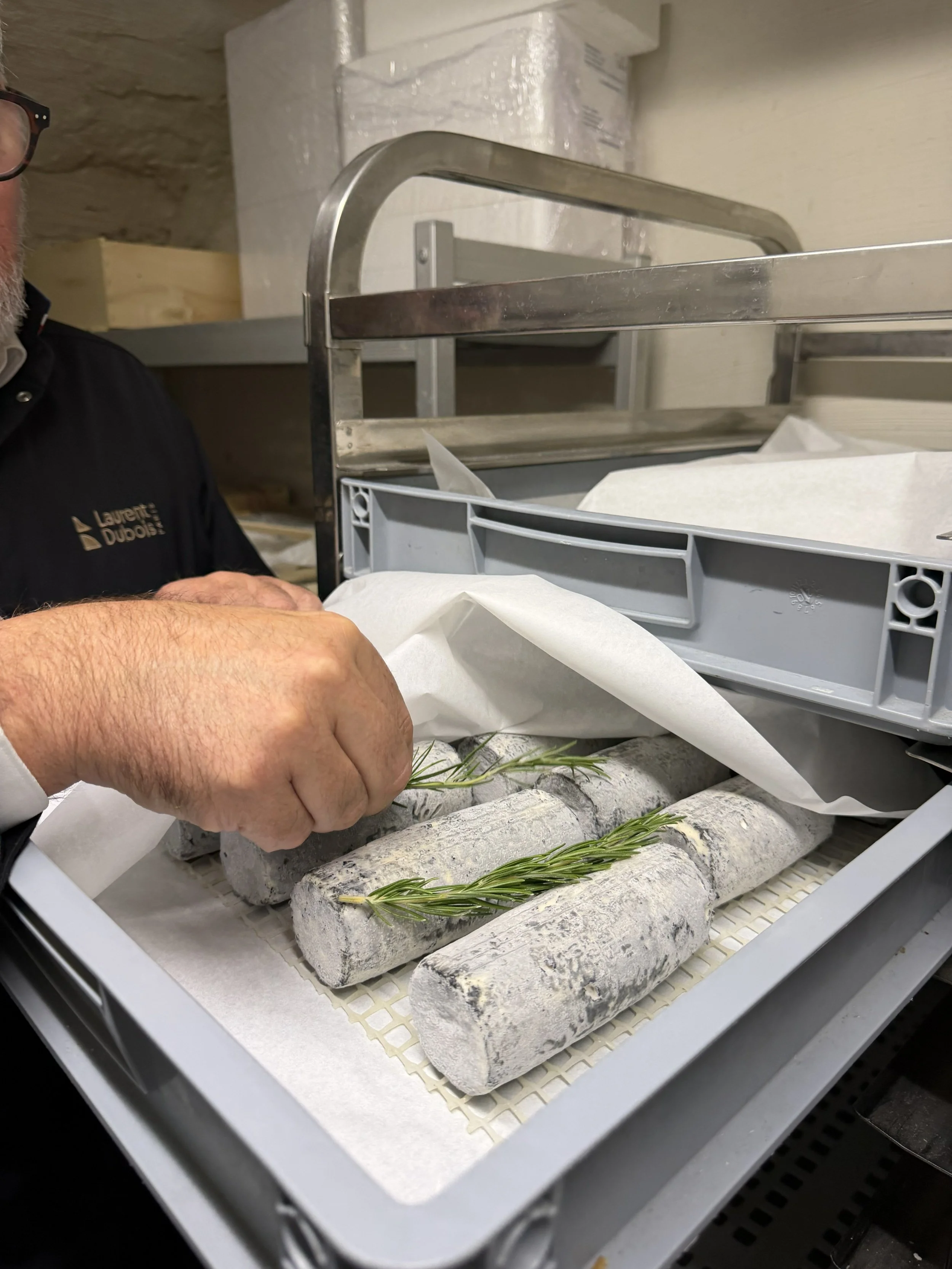
Some of the goat cheeses in the Dubois caves
For cheeses he thinks have potential, he does a fair amount of anaerobic long aging. We tasted a Selles-sur-Cher with a remarkable texture and flavor profile. But all of the cheeses on display are selected at their prime, and only those that are anticipated to be sold that day are presented in the shops; the others remain in the caves to ensure the best quality.
Innovating and Advocating

Another Dubois creation, buffalo milk camembert with pesto, pine nuts and sundried tomatoes
In the 30 years since opening his first store, Dubois has remained passionate about showcasing the finest traditional cheeses and preserving cheesemaking traditions. “I didn’t think that raw milk cheese and artisanal cheese would have such little support today, and that we as cheesemongers, cheesemakers and farmers would have to fight as much as we do to protect this.”
Dubois is happy to see how artisans, cheesemongers, and experts are increasingly trained and eager to learn more and improve, and he feels social media is essential for sharing knowledge to inform customers and a wider audience.
“For us as cheese ambassadors, social media is both useful and important to communicate our stories, our products, and to promote everyone involved in the chain from farm to plate. And of course it’s useful from a commercial perspective for marketing and sales.”
He’s also pleased with how cheese has evolved in how it’s enjoyed. “Whereas cheese used to be very much on a cheeseboard or used in some regional traditional recipes, it is now everywhere. Cheese is now very present and eaten at all times of day in all manner of recipes, presentations, and creations.”
Innovation and perfecting the art of affinage continue to inspire him, as does exploring different territories for exchanges and research with cheese colleagues. In recent years, he has traveled to Brazil, Japan, Australia, Algeria, and Kazakhstan, just to name a few.
“My goal is to continue learning more about different cultures, and offer guidance and support for those in our industry. I want to diffuse and share the world of artisan cheese, and pass on my humble knowledge of the profession to the young colleagues who come through my fromageries.” A mission that seems impossible to be replaced by AI anytime soon.