
A Curious Irish PDO Cheese That Nobody Seems to Know
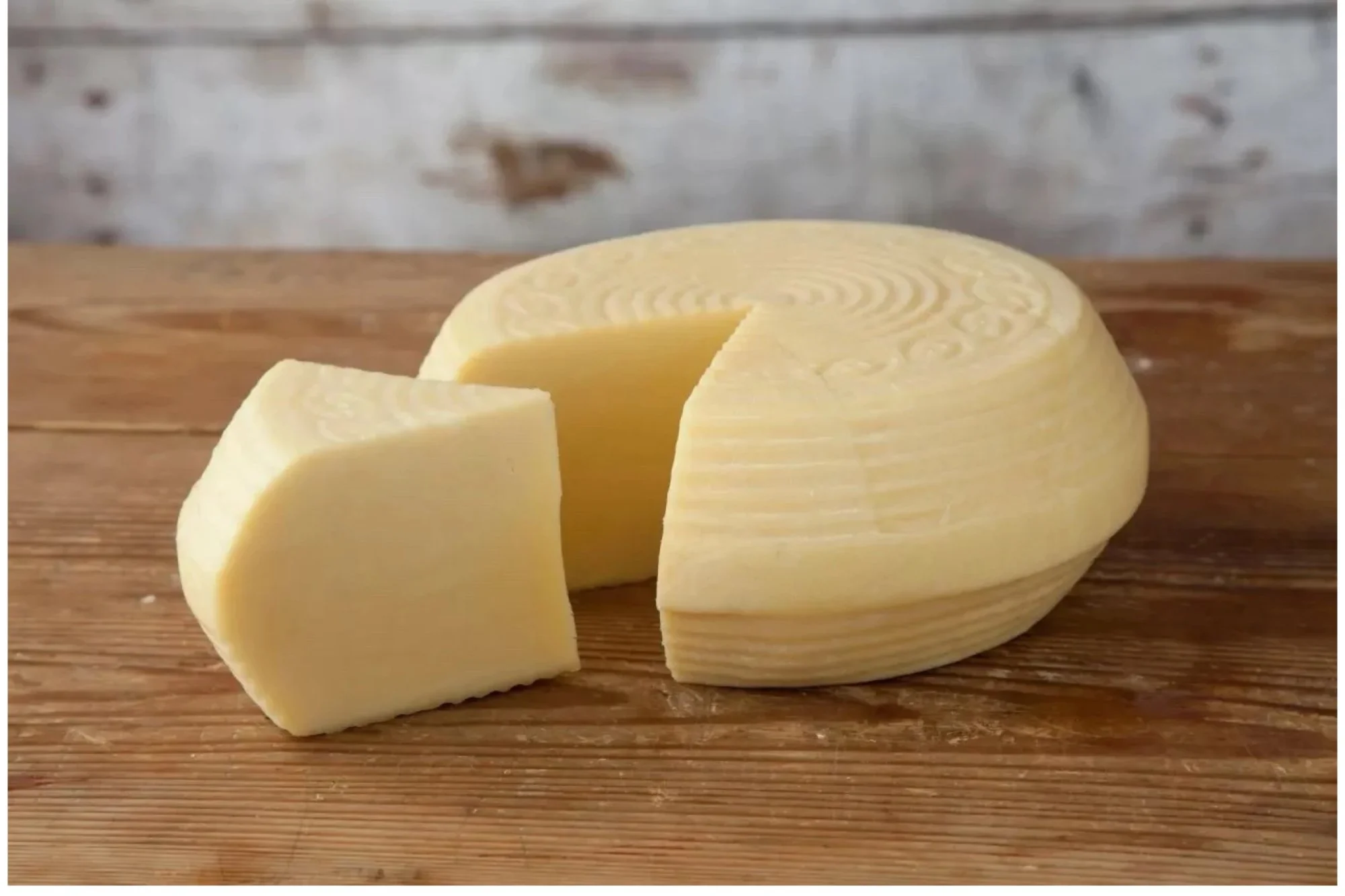
Imokilly Regato wheel
Comté. Parmigiano Reggiano. Gruyère. Stilton. Feta. From Sweden to Greece and everywhere in between, many European cheeses known around the world tend to have something in common: name-protected status.
The European Protected Designation of Origin (PDO) system was created as part of the European Union to protect the names of European products, and it officially began in the 1990s. In some cases, it overwrote previous national or regional systems that had been in place for much longer, but regardless, the point was and is to protect food products whose names and natures cannot be divorced from their native territories and traditions. There are notable outliers such as Gouda, Cheddar, and Brie — where name protection only extends to very specific expressions within those broader categories — but more often than not, the most distinctive cheeses from EU countries have this legal halo of name protection and quality assurance around them.
In countries like France and Italy, dozens of cheeses have PDO status. While these lists include cheeses that are famed worldwide, such as Époisses and Gorgonzola, they also include cheeses with much smaller production that may or may not be known outside their region. Even countries such as Austria whose cheeses aren’t exported as broadly has at least a few PDOs cheeses to mention. And then there’s Ireland, an undisputed dairy legend among European countries, and its puzzling, singular, name-protected cheese.
The Mysterious Case of Ireland’s Unusual PDO Cheese
Before naming the cheese in question, consider Irish dairy more broadly to understand why Ireland has only one PDO cheese. There’s a decent chance you have Irish butter in your kitchen right now, given its wide distribution and favor among chefs. If you’ve ever spent a day in Ireland outside of greater Dublin, and especially in its southwestern counties, you’ll know well that lush green pastureland, grazed upon by healthy animals with plenty of space to roam, dominates the landscape.
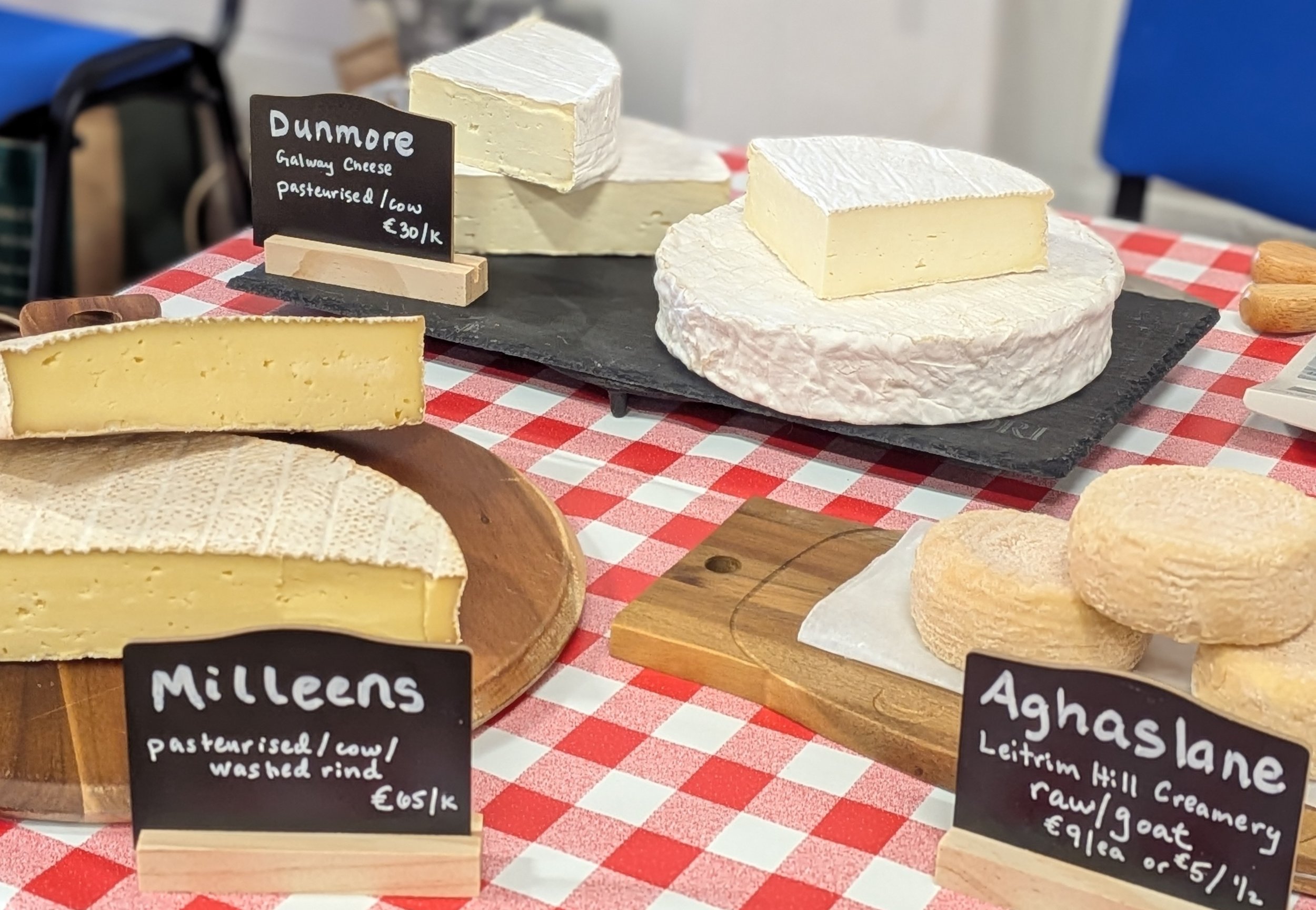
Ireland farmstead cheeses photo credit PV
Ireland has an abundance of renowned, farmstead cheeses, including Milleens, Cashel Blue, Gubbeen, Durrus, Coolea, and St Tola, and several others that have more recently come into being. Dubliner, while an industrially produced cheese, has an Irish moniker and a unique personality: a crumbly hybrid between Cheddar and other hard European cheeses. So, which among these is the cheese whose name is absolutely inextricable from its Irish terroir and heritage?
None. Ireland’s sole name-protected cheese is called Imokilly Regato. Heard of it?
No worries. Neither have many in Ireland.
Imokilly Regato: an Irish Cheese with Italian Style
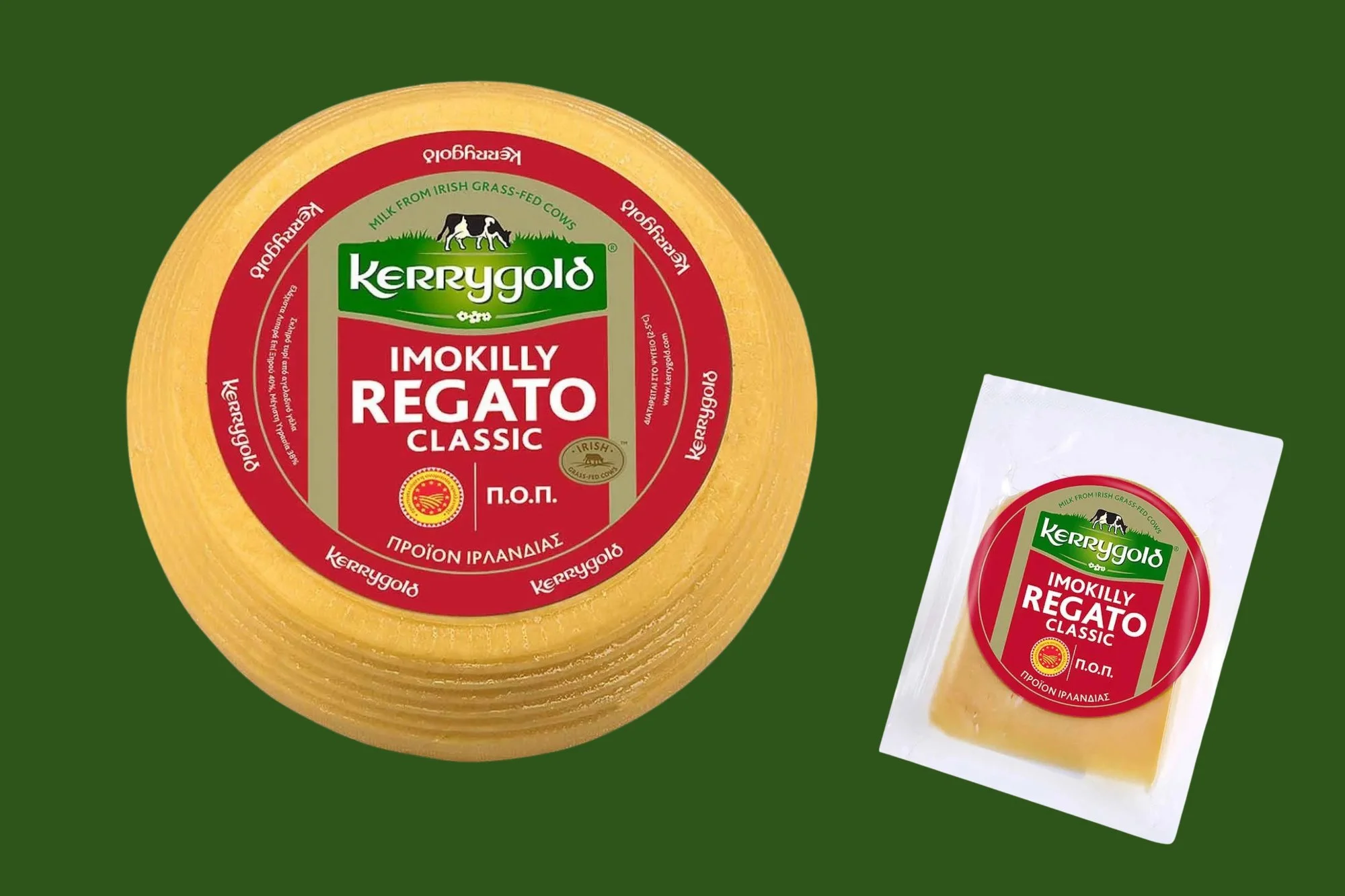
Kerrygold Imokilly Regato Classic
Despite being an Irish homeowner with both access to and interest in Irish curds, I came across the very existence of Imokilly Regato not because I found it in the wild, but rather standing out as Ireland’s sole PDO cheese among a comprehensive online list of European PDO cheeses. (Read: Wikipedia.) As might have been the case for you a few paragraphs ago, my first thought was, “now that’s a funny name for an Irish cheese.” And indeed, on several occasions when asking around locally about Regato, many people — even some Irish cheesemakers — are surprised to learn that Ireland has a PDO cheese at all.
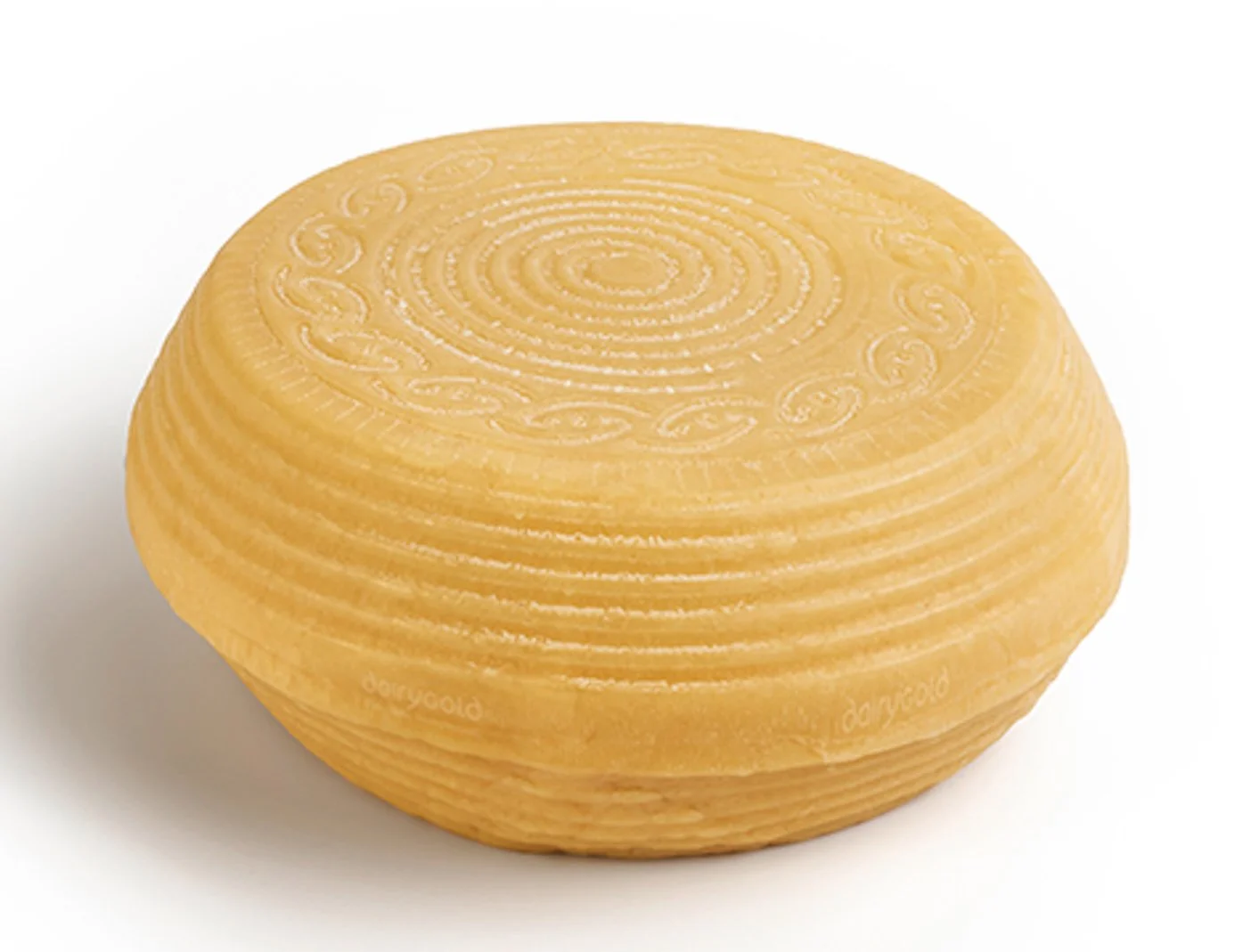
Dairygold Imokilly Regato
Regato is described by those who make and distribute it as Italian in style, hence its name. According to Dairygold, a dairy cooperative near the barony of Imokilly where the cheese originates, describes it as such: “Imokilly Regato PDO has a piquant Italian flavour, dry firm texture and a light golden-creamy colour. It is characterised by delicate aromas of pears, fudge and butter and has a delicious nutty and creamy taste with a piquant finish.” Kerrygold, of Irish butter fame, which distributes Regato Classic to Europe under its livery also notes its “Italian style, Irish soul.”
Regato was born between the merging of two industrial dairy cooperatives in Ireland’s southernmost County Cork in 1973, just ahead of the Irish farmstead cheese renaissance. (More on that moment to come.) Wanting to show off County Cork’s unparalleled milk supply, which contains a high level of beta-carotene given weather conditions that allow for an extended grazing period, a new cheese to establish the new operation was called for, using a historic, regional recipe and rennet cultivated specifically for this new expression. A special mold gives Regato its signature shape: a small wheel with convex sides embossed with a Celtic cord pattern.
With Irish milk and an Irish design, Regato’s Italian name is due to its intentionally Italian Grana nature: finely cut, cooked curds are pressed into molds, then wheels of Regato are salted twice before aging out for at least nine months. This process is shared by Italian PDO cheeses such as Parmigiano Reggiano and Grana Padano. As a result, Regato is a distinctly culinary cheese: perfect for “pizzas, jacket potatoes, pasta dishes, and savoury bakes, including quiches,” according to Dairygold. Given the above tasting notes, like its Italian cousins, it’s doubtlessly also good for snacking.
The pursuit of a PDO for a cheese that was already a kind of tribute cheese unto itself speaks more to the size of the industrial brand(s) behind it, than to the risk of it being replicated. Speaking from experience, it’s a devil to even find. Admittedly, I have yet to go to County Cork, but neither Ireland’s biggest grocers, its largest cheese seller, nor a few specialty shops between Galway and Dublin have even heard of it, much less carry it. Compare that to something like France’s Comté, which is as ubiquitous as Italian mozzarella. You may more easily find Regato keeping company as shreds with mozzarella and other "Mediterranean" cheeses in Dunnes Stores packaging than you would whole wheels or wedges. It even seems that it may be easier to find in Germany or Greece than in Ireland.
The Role of Colonialism in Ireland’s Cheese History
Imokilly Regato itself and its elusive nature is only half the story of Ireland’s only PDO cheese, however. Why it was the first, and has remained the only PDO cheese for the country is the more crucial puzzle piece.
Like most of the rest of Europe, Ireland has a long history of farmstead cheesemaking. According to Bord Bia, the Irish Food Board, monastic records reveal Irish monks potentially had a hand in teaching cheesemaking at monasteries in mainland Europe as early as the seventh century. Unlike most of Europe, English occupation in the 16th and 17th centuries in Ireland stripped farmers of their land, and along with it, their local cheese traditions, and converted most cheesemaking operations on the Emerald Isle to Cheddar, which was a well established style at that point.
In the modern cheese age, Irish Cheddar is a force to be reckoned with, but as a point of comparison on the PDO score, the United Kingdom has nearly 20 PDO cheeses to its name, most of which have centuries of history. Ireland should be no different, were it not for English occupation. In a report from the Journal of the Cork Historical and Archeological Society, indigenous Irish cheeses included those in both firm and soft styles such as Millsen, Gruth, Tath, and Tanag. (The latter, a hard cheese, features in Ireland’s oldest folktale, believed to be the instrument that killed warrior Queen Maebh when launched at her head, but that’s a story for another day.)
Are More Irish PDOs on the Horizon?
Cáis, the Association of Irish Farmhouse Cheesemakers, was formed in 1983, facilitated by the National Dairy Council, in order to give support to what was then a burgeoning Irish farmstead cheese renaissance. After Irish independence in 1921, the Irish dairy industry was still dominated by industrial co-ops, including that which developed Imokilly Regato, until Milleens came about as Ireland’s first modern farmstead cheese in 1976. The best known Irish cheeses in Ireland and beyond have about the same longevity as American dairies such as Cypress Grove and Vermont Creamery, albeit in a country with a much longer history not only of cheesemaking, but of even existing.
So, is there any momentum among Ireland’s current crop of farmstead cheesemakers to pursue PDOs for their well-deserving, terroir-driven cheeses? “Some of us have looked at it over the years,” says Siobhán Ní Gháirbhith, owner and cheesemaker of goat’s milk St Tola, “but we felt the investment required in bureaucracy didn’t justify the effort.”
In a sentiment that small cheesemakers around the world can also probably relate to, “there was a group here in Cork approached to do a PDO for washed rind cheese,” says Clovis Ferguson of Gubbeen Farmhouse Products, maker of one Ireland’s best known washed rinds. “None of us could get enough time off to deal with the paperwork or to meet.”